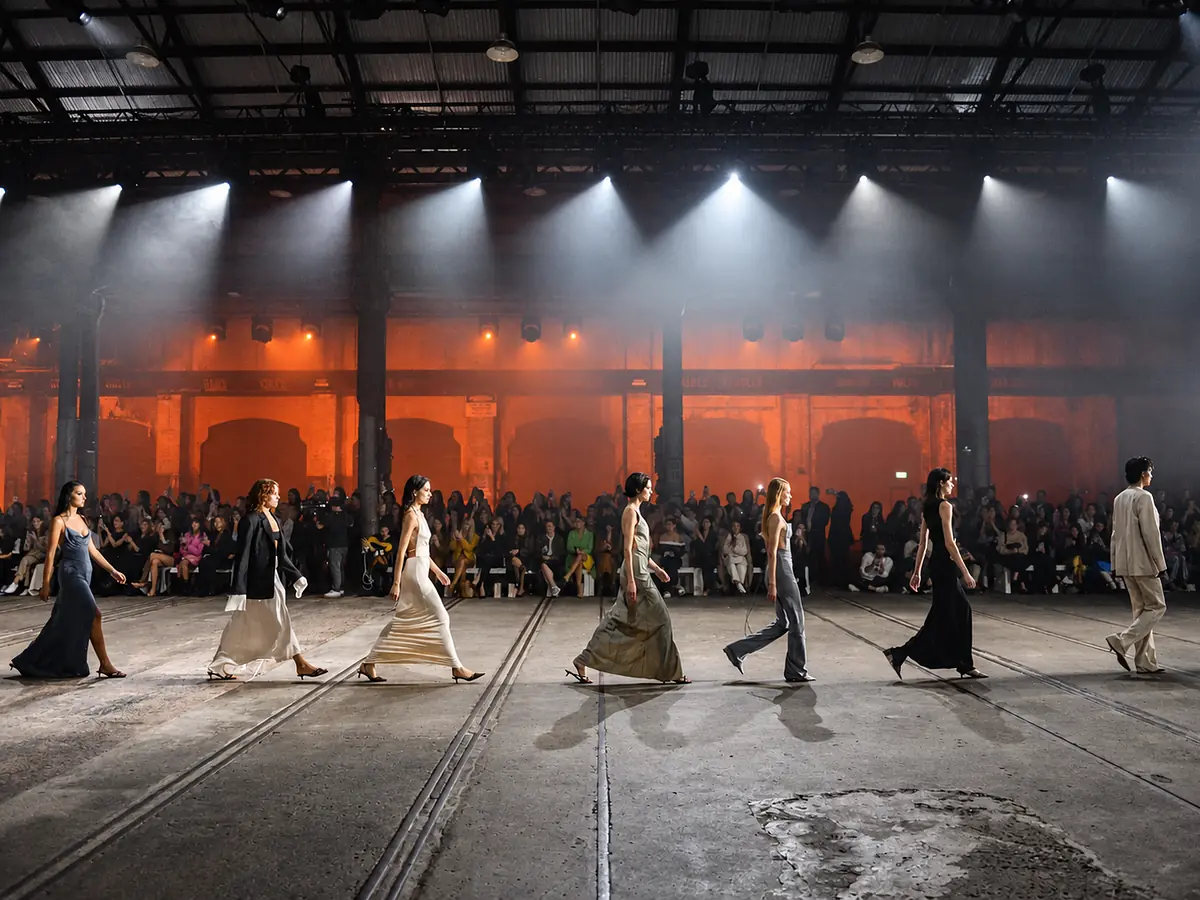
Paris hosts not one but several editions of Fashion Week every year, spread across the calendar: Men's Fashion Week in January and June, Haute Couture in January and July, and Women's Fashion Week from late February to early March and again from late September to early October for the ready-to-wear collections. This succession of events makes the capital one of the world's essential fashion centres, alongside Milan, London and New York, with a professional calendar of rarely equalled density over such a short period.
The logistical particularity of Paris Fashion Week lies in how widely the show venues are spread, far more than in Milan or London, where events are often concentrated on fewer sites. In Paris, fashion houses and young designers take over in turn the Grand Palais and large venues where groups hold several consecutive shows, but also more confidential places: private mansions in the Marais, museum courtyards or even private gardens revealed only a few days before the event.
This spread is a major challenge for anyone, journalist, buyer, guest or industry professional, who has to attend several shows in the same day, sometimes less than an hour apart and kilometres from one another. A show missed because of a transport delay is not just an inconvenience: in the highly codified world of fashion, an empty front-row seat can affect future professional relations with the house organising the show.
This is precisely where a dedicated private chauffeur becomes a decisive ally rather than a simple comfort. Unlike a taxi booked journey by journey, whose availability becomes unpredictable around show venues swarming with crowds and photographers, a chauffeur waiting close to the venue, in constant contact with the client about the progress of the current show, allows a smooth transition from one appointment to the next with no last-minute improvisation.
Access to the show venues themselves is particularly difficult during this period: the streets around the Grand Palais or the private mansions requisitioned for the occasion are often closed to traffic or reserved for accredited vehicles, with reinforced security for the most anticipated shows. A chauffeur used to these constraints anticipates the authorised drop-off points and avoids the unnecessary detours that penalise a visitor discovering these restrictions for the first time.
Fashion Week clients are particularly varied: international buyers placing orders for their boutiques, fashion journalists covering several shows a day to feed their newsrooms in real time, influencers and content creators whose schedule can change at the last minute depending on the invitations they receive, and of course the houses themselves, which have to transport models, technical teams and artistic directors between rehearsal spaces and show venues.
For this last group, the fashion houses and their teams, vans dedicated to carrying clothes rails, collection trunks and technical equipment are often needed on top of saloons for executives and guests of honour, which calls for fine logistical coordination between several vehicles in use at the same time over several consecutive days.
A typical Fashion Week day can include three or four different shows, from early morning to late evening, interspersed with showroom appointments where buyers discover the collections in a more intimate setting, away from the buzz of the catwalks. This alternation between high-profile shows and private showroom appointments calls for a flexibility of schedule that only a chauffeur dedicated for the day can absorb easily.
The hotels of the Golden Triangle and Saint-Germain-des-Prés, where a large share of Fashion Week's international clients traditionally stay, become key meeting points for transport during this period, with frequent group departures to the same show shared by several guests of the same hotel at the same time.
The evening, far from marking the end of the professional programme, often extends Fashion Week with dinners hosted by the houses, collection launch parties or private receptions in iconic venues across the capital. These events, which sometimes continue late into the night, keep demand for transport high well after the last show of the day, which makes continuous hire all the more worthwhile than a succession of one-off bookings.
Haute Couture, held at the end of January and bringing together a smaller number of houses in venues often steeped in history, such as some private mansions in the 8th arrondissement, attracts clients who are even more demanding in terms of discretion and prestige, as the guests at these shows are among the most loyal clients of the houses concerned and deserve particular attention from the moment they are collected at the airport or their hotel.
For professionals who return to Paris Fashion Week every season, keeping a chauffeur already familiar with the usual venues, the shortcuts between arrondissements and each house's access procedures is a valuable asset, saving significant time from the first hours of each new edition without having to rebuild these reference points with a provider discovering the period for the first time.
Men's and women's Fashion Weeks, although organised along similar lines, differ noticeably in calendar and intensity: the men's week, more compact, generally concentrates its activity over four to five days, while Women's Fashion Week in September and October lasts a full week with a far greater volume of shows and professional appointments, creating logistical pressure comparable to that of the largest trade fairs in Paris.
Booking ahead is especially important during these periods: demand for private chauffeurs far exceeds the available supply as soon as the official dates of each edition are announced, particularly for the slots of the season's most anticipated shows. Booking several weeks in advance, ideally with the full planned programme for the week, remains the best way to secure an available chauffeur for the whole period rather than settling for whatever is left at the last minute.
Press and professional accreditations, issued by the Fédération de la Haute Couture et de la Mode for all these events, determine access to the different show venues and directly affect transport planning: a chauffeur who knows the type of accreditation their client holds can better anticipate the most relevant drop-off point according to the level of access authorised at each venue.
For international visitors discovering Paris Fashion Week for the first time, a chauffeur able to offer practical pointers on how the week unfolds, where the different venues are and the best times to travel between two appointments goes beyond driving alone and is a real asset in a world as codified and professionally high-stakes as Paris fashion.
Finally, beyond the Fashion Weeks, Paris hosts other major luxury and fashion industry events throughout the year, such as Maison&Objet in Villepinte for interior decoration and design, which follow a comparable transport logic. The experience gained at an event as demanding as Fashion Week, with its scattered venues, restricted access and international clients used to the highest standards of service, is directly transferable to all the major luxury events held in the capital.
Pop-up showrooms, set up for the occasion by many houses in Haussmann-era apartments or private mansions rented specifically for Fashion Week, add a further layer of geographical spread to manage. Unlike the shows themselves, whose times and venues are generally known several weeks in advance, some showroom appointments are confirmed at the last minute, calling for a responsiveness that only continuous hire can absorb without delay.
The Sentier and Marais districts, where many young designers and emerging brands set up alongside the great historic houses, have particular traffic constraints because of their narrow streets, which makes a chauffeur's detailed knowledge of these arrondissements all the more useful to optimise each drop-off between two appointments close together in time but sometimes complicated to reach by car.
The international media present in large numbers during Fashion Week, film crews, photographers and newsrooms covering the event live for their audiences, also have specific transport needs, often with bulky technical equipment to move from one show venue to another within very short time frames between two shoots, a logistical requirement that brings their needs closer to those of the houses themselves than to those of an ordinary guest.
On the economic side, Fashion Week generates considerable benefits at every edition for hotels, restaurants and all of Paris's luxury services, premium transport being just one link in a temporary but extremely dense ecosystem that takes shape several times a year to the rhythm of the collections.
The great houses historically based on Avenue Montaigne and Rue du Faubourg Saint-Honoré also hold private presentations of their collections outside the official show calendar for loyal clients and privileged buyers, generating a year-round flow of individual appointments that calls for the same punctuality and discretion as in the middle of Fashion Week, confirming that this know-how remains in demand well beyond the official dates.