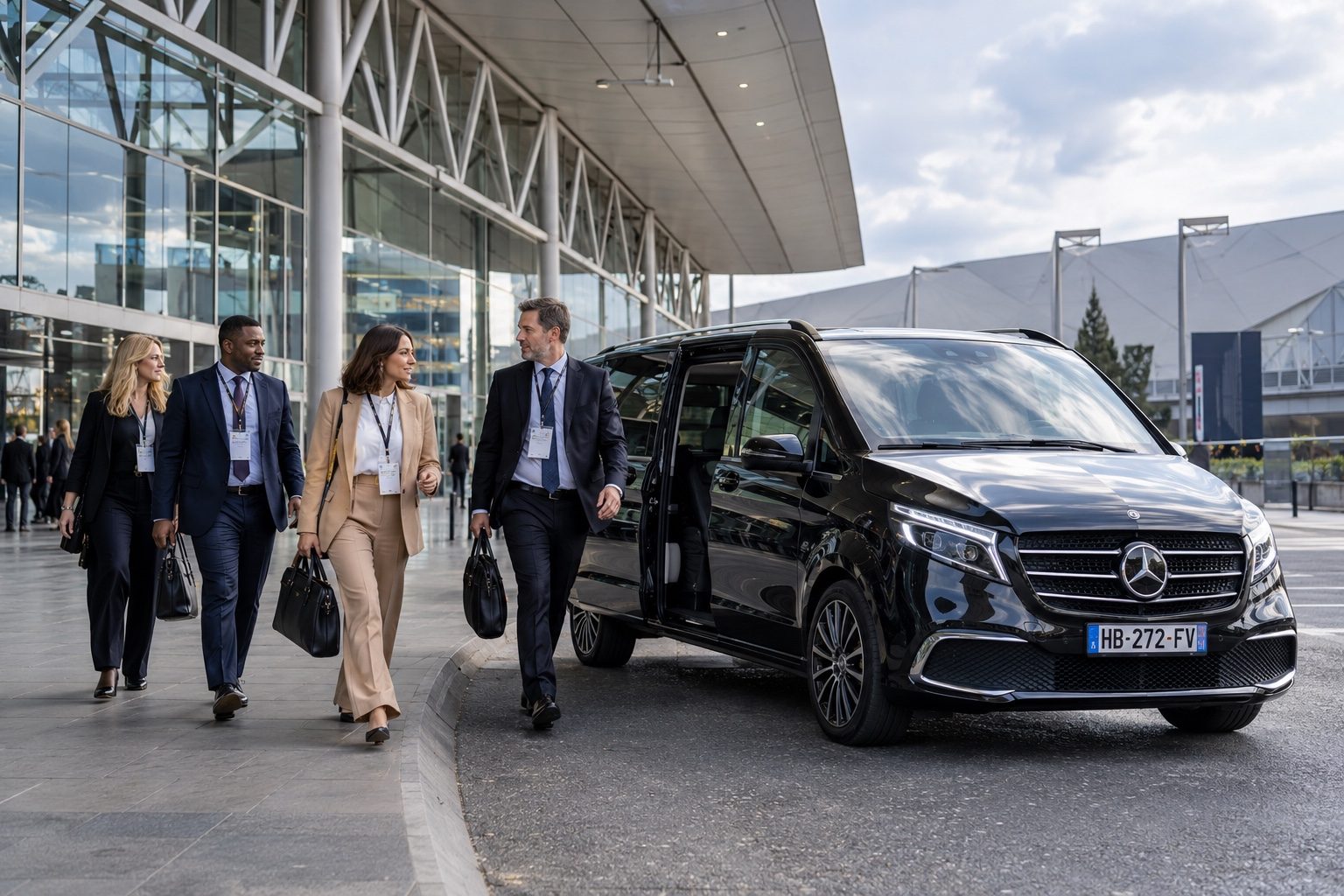
Paris and its region have one of the largest exhibition infrastructures in Europe, spread over several sites, some located far from the city centre: the Paris Expo Porte de Versailles exhibition centre in the 15th arrondissement, the Paris Nord Villepinte exhibition centre near Charles de Gaulle airport and, to a lesser extent, Le Bourget for aviation-related events. This geographical spread calls for specific logistical planning for any company organising a delegation's trip to one of these fairs.
Porte de Versailles, the most central of these major sites, hosts a considerable number of fairs throughout the year, from the International Agricultural Show in February and March to Paris Games Week in the autumn. Its relative proximity to central Paris, in the 15th arrondissement, makes it reachable in twenty to thirty minutes from most central Paris hotels, a journey that can nevertheless become noticeably longer at rush hour or during the largest fairs, which temporarily saturate access to the district.
Villepinte, by contrast, is right next to Charles de Gaulle airport, a good half-hour from central Paris in normal traffic. This location, designed to make access easier for international visitors coming straight from their arrival flight, means a longer journey for delegations staying in central Paris, a factor to build precisely into the organisation of daily rotations to the fair.
Maison&Objet, held twice a year in Villepinte and bringing together the entire international interior decoration and design industry, illustrates this well: professionals exhibiting at or visiting this fair generally need regular rotations between their Paris hotel and the Villepinte site over several consecutive days, a pattern that fully justifies hiring a chauffeur by the day rather than booking a succession of individual journeys.
For a company delegation of several employees, the size of the transport depends directly on the number of people to move at the same time and how closely their arrival and departure times need to be synchronised. A small delegation of two to four people generally needs one or two saloons, while a larger team with presentation or stand equipment quickly requires vans able to carry both the staff and their equipment.
The International Agricultural Show, held every year at the end of February at Porte de Versailles and drawing particularly large crowds over its nine days, puts significant logistical pressure on access to the 15th arrondissement, with long queues around the exhibition centre from the morning, particularly at weekends, which draw more families than the weekdays, more oriented towards professionals.
Paris Games Week, the video game fair also held at Porte de Versailles in the autumn, attracts a younger but equally large audience, with particularly marked peaks at weekends and at the end of the day, when visitors all leave the fair at the same time towards the main exit of the exhibition centre.
For international delegations arriving specifically for a fair, coordinating the arrival airport transfer with the first journey to the fair deserves particular attention: a flight landing early in the morning at CDG can allow a direct transfer to Villepinte without stopping at the hotel if the fair programme starts at opening time, an arrangement that does, however, require planning the luggage logistics for the rest of the stay.
The return journey at the end of a fair day also needs careful planning, particularly at Porte de Versailles, where the major fairs create a departure peak concentrated in the last hour of opening, with all visitors and exhibitors trying to leave the site at the same time. A chauffeur waiting in advance at an agreed meeting point, rather than looked for on the spot in the middle of the departing crowd, avoids most of this wait.
Exhibitors, unlike visitors, generally spend longer on site, from setting up the stand several days before opening to dismantling it after the fair closes, which calls for a different transport organisation, with rotations potentially needed outside public opening hours, particularly early in the morning or in the evening for stand set-up and dismantling.
For fairs lasting several consecutive days, weekly hire, with one or more chauffeurs assigned to the delegation for the whole event, ensures continuity of service and in-depth knowledge of the group's habits, avoiding having to rebuild the logistical reference points every day with a different chauffeur.
Meetings on the fringes of the fairs themselves, often held in restaurants or reception venues in central Paris for negotiation lunches or dinners between business partners, add a further layer of logistical complexity alongside the official fair programme, requiring a chauffeur available flexibly enough to adapt to frequent changes of plan.
Le Bourget, beyond its role as a business airport, hosts the International Paris Air Show in odd-numbered years, an event of considerable scale that attracts professional and government delegations from all over the world. For some of these delegations, arriving by private jet directly at the show site with an immediate transfer to the exhibition chalets illustrates how this event differs logistically from the other major Paris fairs.
To organise transport for a delegation to a Paris trade fair as well as possible, it is best to share the whole planned programme when booking: number of employees, preferred arrival and departure times each day, any meetings outside the fair site, and any specific needs for transporting equipment or documentation, so that the logistics can be planned as a whole rather than day by day with no overall view.
The variety of professional profiles at these fairs, from company directors to stand technicians, international buyers and specialist journalists, calls for particular adaptability from the chauffeurs involved, between representation requirements for some journeys and simple logistical efficiency for others, a versatility gained through repeated experience of these events edition after edition.
In fact, the Paris trade fair season covers almost the whole year, with particular concentrations between January and March and in September and October, a period that also coincides with the Fashion Weeks and other major events in the capital's business calendar. This busy calendar makes it all the more worthwhile for companies that attend these events regularly to build a lasting relationship with a transport provider able to anticipate each edition, rather than rediscovering the logistical constraints with every new participation.
The Salon du Chocolat, held at Porte de Versailles in the autumn, illustrates the variety of visitors this site welcomes throughout the year, each fair with its own peaks and local traffic constraints that transport teams must reassess at each new edition rather than applying the same pattern from one fair to the next.
For event organisers themselves, often responsible for coordinating the logistics of several hundred speakers and guests at a given fair, setting up a dedicated shuttle between one or more partner hotels and the exhibition site is a frequently adopted way to simplify overall transport management, in addition to the individual chauffeurs booked for the most important speakers or VIP delegations.
Parking at the sites themselves should also be anticipated: the car parks at Porte de Versailles and Villepinte, although designed for a large number of vehicles, fill up quickly during the largest fairs, which makes a direct drop-off by a chauffeur, followed by the vehicle leaving immediately rather than parking for a long time, far more efficient than looking for a space at peak times.
Finally, for international companies discovering the Paris trade fair ecosystem for the first time, it is worth remembering that each site, Porte de Versailles, Villepinte or Le Bourget, has its own access codes, its own opening hours for exhibitors before the official public opening and its own logistical specifics, which a chauffeur experienced in these events helps you master with no time lost from the first day.
New Year's Eve, although very different from trade fairs, illustrates in its own way the same concentrated peak in demand typical of the Paris events calendar: the Champs-Élysées and the Seine embankments draw huge crowds every 31 December, with road closures similar to those seen during the major fairs, confirming that the planning method developed for business events applies just as well to the capital's large public gatherings.
For companies that hold their annual convention in different European cities in turn, Paris has the comparative advantage of one of the largest ranges of conference rooms and exhibition centres on the continent, but in return calls for booking transport further ahead than in less dense cities, as demand for professional chauffeurs is structurally higher there whenever several major events overlap in the same week.