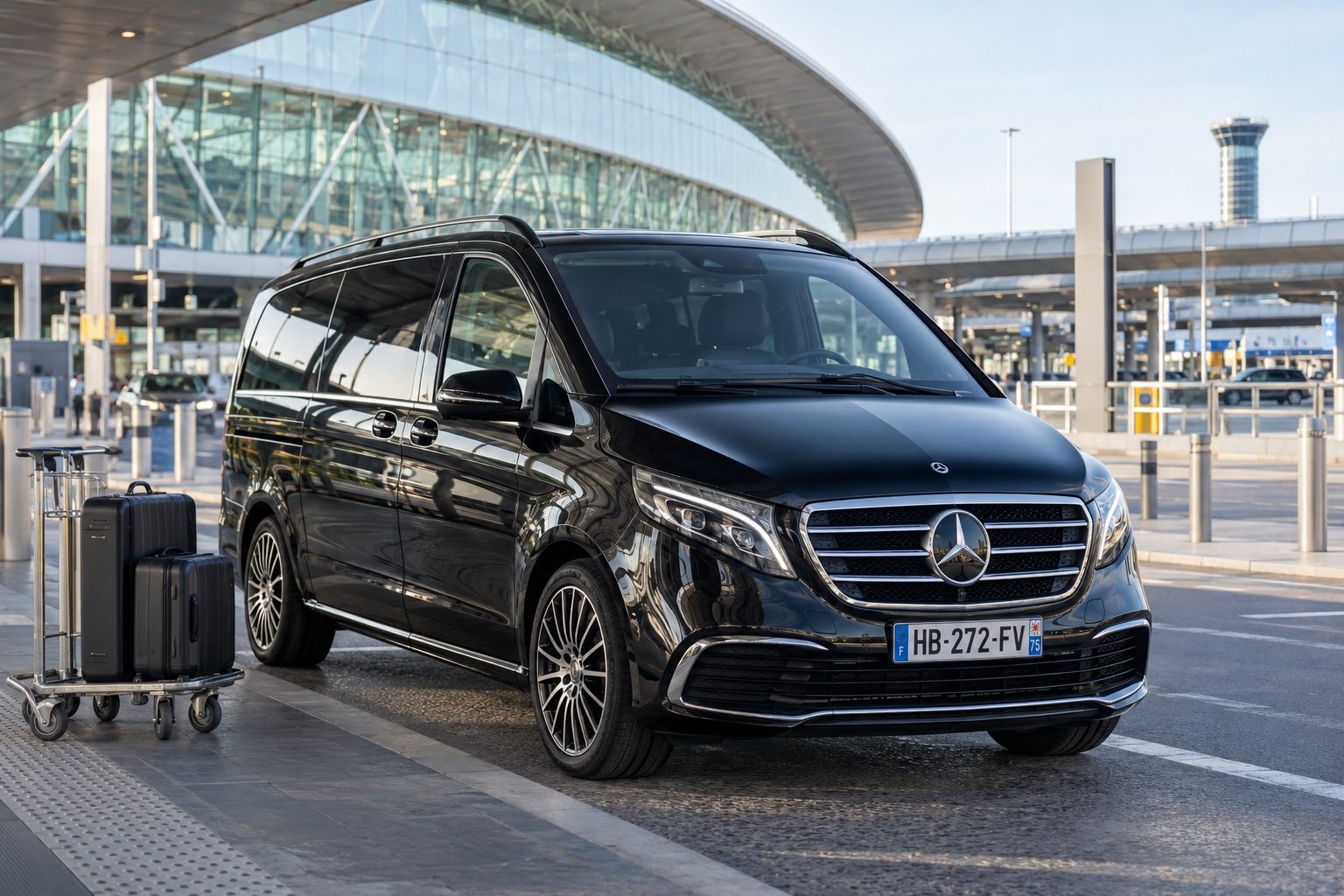
Paris holds a special position among the world's major capitals: it is served not by one but by three airports with radically different profiles, Charles de Gaulle, Orly and Le Bourget, each with its own traffic constraints, journey times into the centre and access procedures. Understanding these differences before you travel lets you plan a transfer with no unpleasant surprises, whichever airport you finally land at.
Charles de Gaulle, around twenty kilometres north-east of Paris, is the largest of the three Paris airports and handles most intercontinental long-haul traffic. Its size calls for a more generous time margin for baggage reclaim and leaving the terminal, particularly at Terminal 2E, which handles a large share of long-haul flights and whose internal distances can surprise first-time visitors. A chauffeur used to this route always builds this margin into the pick-up time, avoiding a frustrating wait in the arrivals hall.
The journey between CDG and central Paris generally uses the A1 motorway and then the Périphérique, taking forty-five minutes to an hour on average in normal traffic, a time that can easily double at weekday morning and evening rush hours, especially at the end of weekends or school holidays, when traffic on this route is heavy. A chauffeur following traffic in real time can choose an alternative route via the A3 or the Francilienne depending on conditions, an adjustment that a fixed route planned in advance would not allow.
Orly, closer to central Paris to the south of the city, mainly serves European and domestic routes and some destinations in North Africa and the French overseas territories. The journey to the Left Bank or the 7th, 14th or 15th arrondissements is generally faster than from CDG, around thirty to forty minutes in normal conditions, except at rush hour, when the southern Périphérique and the A6 can slow traffic considerably, especially approaching Porte d'Orléans or Porte d'Italie.
Orly's terminals, Orly 1, 2 and 3 on one side and Orly 4 on the other, with airlines allocated to one or the other, are not always intuitive for an occasional traveller. A chauffeur who tracks the flight and the arrival terminal given at booking avoids any confusion about the exact pick-up point, a detail that can waste precious time if the wrong terminal is given by mistake.
Le Bourget has a special place among the three Paris airports: dedicated exclusively to business aviation and private jets, it does not have the same passenger flows as the two commercial airports, but calls for different coordination, with the chauffeur waiting at the exit of the business aviation terminal and timing based on the actual landing time rather than the scheduled time given before the flight. This flexibility is one of the main advantages of this airport for international business travellers with changing schedules.
The choice of arrival airport is not always up to the traveller, as it depends above all on the routes available from their departure city, but when there is a choice between several flights for the same final destination, Orly's relative proximity to central Paris can save significant time compared with CDG, particularly for an early-morning meeting in the central arrondissements or on the Left Bank.
For travellers with tight connections or early flights, CDG offers unrivalled worldwide air connectivity in France, with a very large number of direct flights to the world's main cities, while Orly is often preferred for point-to-point European routes, notably from major economic capitals such as London, Madrid or Rome, with frequent flights throughout the day.
Whatever the airport, the key to a smooth transfer is the same: a chauffeur who tracks the flight in real time using the flight number given at booking, knows the specific access procedures for each terminal and airline, and adjusts the route into Paris according to traffic conditions at the time rather than following a fixed route decided in advance regardless of the day's events.
Luggage should also be anticipated differently depending on the destination airport. At CDG, the baggage carousels in the long-haul terminals can mean longer waits than at Orly, particularly for flights arriving together within a short window from Asia or North America. A chauffeur aware of this likely delay adjusts their arrival time in the hall to avoid an unnecessary wait while being ready as soon as the passenger actually comes out.
For stays combining several stages, for example arriving at one airport and leaving from another after a change of plan during the trip, the two transfers are best coordinated together at the initial booking rather than case by case, ensuring continuity of service with the same attention to each stage of the journey between the three Paris airports.
Alongside its usual business aviation activity, Le Bourget also hosts the International Paris Air Show in odd-numbered years, an event that temporarily turns the area into a magnet for tens of thousands of professional and public visitors. During this period, roads around the airport are unusually busy, something a chauffeur familiar with the area knows how to anticipate, whether for a private jet arrival coordinated with the show or for a simple business transfer into Paris.
The Paris low-emission zone, which covers the entire area inside the A86, also applies to journeys from the three airports into central Paris. A professional vehicle with the current Crit'Air sticker travels without restriction, a reassuring point for international visitors who often discover this regulation for the first time on arrival and wonder whether it affects their transport.
The earliest and latest flights deserve a special mention: landing at CDG after midnight or before six in the morning calls for different planning, with much lighter traffic on the motorways but extra attention to the chauffeur's actual availability at a time when ordinary transport, taxis included, becomes much scarcer than during the day.
For families or groups travelling with young children, the question of car seats depends on the airport and the expected journey time: a longer journey from CDG makes it all the more important to request a seat suited to the child's age in advance, a service to mention when booking to guarantee its availability on the day of the transfer.
Finally, for travellers still hesitating between several flight options to Paris, it can help to ask for personalised advice that takes into account the precise final destination in the capital, the expected arrival time and the number of passengers and bags, as each combination can point to a different best choice between CDG, Orly and, for business clients flying privately, Le Bourget.
Far from being a mere administrative complication, the diversity of these three airports actually offers valuable flexibility to travellers who know how to use it: choosing your arrival airport according to your final destination in Paris, the time of your meeting and the type of aircraft lets you, with a chauffeur who knows each airport inside out, make the most of every minute between landing and arriving at your destination in the city.
Connections between CDG and Orly, sometimes necessary for travellers changing airline or combining a long-haul flight with a domestic one, pose a specific difficulty that many underestimate: the distance between the two airports, around fifty kilometres by motorway, means a journey of at least forty-five minutes outside peak times, which should be built into any connection plan with a generous safety margin to avoid missing the next flight.
For business travellers whose programme in Paris starts as soon as they land, without stopping at the hotel first, a chauffeur waiting in the arrivals hall with a workspace on board lets them use the journey into central Paris to prepare a meeting or answer business messages, turning transfer time that is usually lost into a productive moment before the first meeting of the day.
The three airports are not equal either when it comes to the strikes and disruptions that occasionally affect air transport or public transport in the Paris region. A private chauffeur generally remains the most reliable solution during these periods of disruption, as it does not depend on the same risks as the RER B to CDG or the bus routes affected, a valuable advantage for travellers whose schedule allows no delay.
Finally, for international clients discovering Paris for the first time, it is worth remembering that the three airports have distinct IATA codes, CDG, ORY and LBG, which should be checked carefully when booking a flight or giving transfer details to your chauffeur, as confusing two airports can cause an avoidable setback at the very end of a journey.
CDG Terminal 1, with its distinctive circular design and home to many international airlines, often involves a longer walk between the gate and baggage reclaim than the more recent terminals, a detail that chauffeurs used to this airport build into their estimate of the time before actually meeting the passenger in the arrivals hall.